
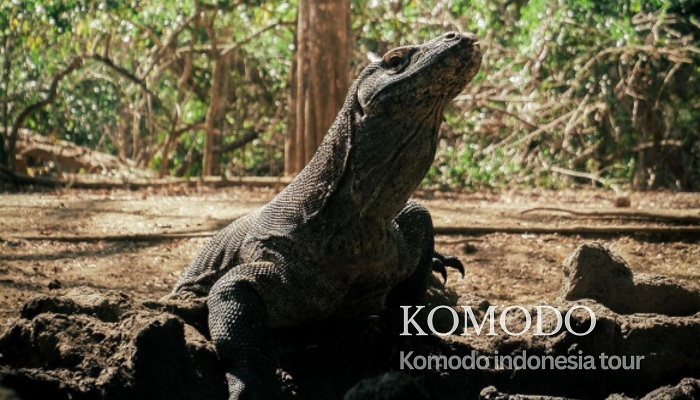
Komodo Dragon Venom and Behavior, The Komodo dragon (Varanus komodoensis) is the largest living lizard on Earth and one of Indonesia’s most iconic wildlife species. Found only in parts of East Nusa Tenggara, these prehistoric predators dominate their ecosystem as apex hunters. Native to the islands of Komodo Island, Rinca Island, Gili Motang, Gili Dasami, and western Flores, they are locally known as “ora” or “land crocodile.”
Protected within Komodo National Park, the Komodo dragon has become a major attraction for nature travelers and Komodo tour visitors worldwide. However, habitat loss and human activity have placed this species on the vulnerable list, making conservation efforts critical.
Adult Komodo dragons typically measure 2–3 meters in length and weigh around 70–100 kg, although exceptional individuals can exceed these averages. The largest recorded specimen reached over 3.1 meters and weighed approximately 166 kg. Their muscular tails are as long as their bodies and serve as powerful weapons and balance tools.
Males are generally larger than females. Skin coloration ranges from dark gray to brick red in males, while females tend to be greenish-brown with yellow throat markings. Juveniles display vibrant patterns of yellow, green, and white on black backgrounds, helping them camouflage in trees.
Their mouths contain about 60 serrated teeth, each roughly 2.5 cm long and coated with iron, enabling them to tear flesh efficiently. These teeth are frequently replaced throughout life. A long, forked tongue—similar to snakes—helps detect chemical signals in the air.
Komodo dragons rely heavily on smell rather than sight or hearing. Using their forked tongues and the Jacobson’s organ, they can detect carrion from distances of 4–9.5 km. Their vision reaches about 300 meters but is poor in low light because their retinas lack rod cells.
Contrary to earlier beliefs, Komodo dragons are not deaf; they respond to certain sounds and vibrations. Their nostrils function mainly for breathing rather than scent detection.
Komodo dragons inhabit open savannas, dry forests, and coastal regions. They are mostly active during the day, especially from late morning to afternoon, seeking shelter when temperatures peak.
When threatened or competing for food, dragons display dominance through hissing, posture, and combat. Larger individuals typically dominate feeding events.
Although famous as fearsome predators, Komodo dragons primarily feed on carrion. However, they are also capable ambush hunters. Prey includes deer, wild boar, goats, water buffalo, birds, reptiles, and occasionally other Komodo dragons.
They attack suddenly, targeting the throat or underside. Their flexible jaws allow them to swallow large chunks—or entire animals—whole. A dragon can consume prey weighing up to 80% of its body weight in a single meal.
Their metabolism is extremely slow; large adults may eat only once per month and survive on about a dozen meals per year.
For decades, scientists believed Komodo dragons killed prey through infected bites caused by bacteria-laden saliva. Modern research has confirmed that they also possess venom glands in their lower jaws.
One bacterium commonly found in their saliva is Pasteurella multocida, which can lead to septicemia if untreated. The combination of venom, blood loss, and infection often ensures that bitten prey dies even if it escapes initially.
This deadly bite mechanism explains why Komodo dragons can bring down animals much larger than themselves.
Mating occurs between May and August. Males fight intensely for access to females, wrestling upright using their powerful forelimbs. Females lay around 20 eggs, usually in burrows or abandoned nests, which incubate for about 7–8 months.
Newly hatched dragons are vulnerable and spend their early years in trees to avoid cannibalistic adults. Komodo dragons mature within 3–5 years and can live over 50 years.
Remarkably, female Komodo dragons can reproduce without males through parthenogenesis. In such cases, offspring are typically male due to the species’ ZW chromosome system. This adaptation allows isolated females on islands to establish new populations.
Documented cases in zoos—including London and Chester Zoos—confirmed viable offspring produced without fertilization.
The Komodo dragon evolved from giant monitor lizards that originated in Asia and migrated through Australia millions of years ago. Fossil evidence suggests modern Komodo dragons appeared about 4 million years ago and later became isolated on Indonesian islands due to changing sea levels.
Europeans first documented the species in 1910, and scientific recognition followed shortly afterward. Their fame grew worldwide, inspiring expeditions, research, and even films.
Today, encounters between humans and Komodo dragons are carefully managed by park rangers. Although attacks are rare, they can be fatal. Tourism must balance visitor safety with wildlife conservation.
The Komodo dragon is classified as Vulnerable by the International Union for Conservation of Nature. Only about 4,000–5,000 individuals remain in the wild, with a limited number of breeding females.
Indonesia established Komodo National Park in 1980 to protect both the dragons and their ecosystem. Additional reserves on Flores also support conservation efforts.
Because of their size and danger, Komodo dragons are rare in zoos. They are susceptible to disease and difficult to breed. However, successful captive programs have provided valuable scientific insights.
Interestingly, captive dragons have shown signs of intelligence and play behavior, interacting with objects such as tools, containers, and toys. Some individuals can recognize familiar handlers.
Despite occasional docile behavior, they remain unpredictable and dangerous wild animals.
Seeing a Komodo dragon in the wild is one of the most thrilling wildlife experiences on Earth. For visitors joining Komodo tours, understanding their venom, behavior, and ecological importance adds depth to the adventure.
These ancient predators are not just tourist attractions — they are vital components of Indonesia’s natural heritage and a symbol of the unique biodiversity found nowhere else on the planet.
The Komodo dragon is a masterpiece of evolution — a giant reptile equipped with venom, powerful jaws, keen senses, and remarkable survival strategies. From solitary hunting behavior to rare reproductive adaptations, this species continues to fascinate scientists and travelers alike.
Protecting Komodo dragons ensures that future generations can witness one of Earth’s last remaining prehistoric predators in its natural habitat — a true highlight of any Komodo Island journey.




Kayangan Harbor: The Gateway to Adventure from Lombok to Labuan Bajo Kayangan Harbor, located on the eastern coast of Lombok Island, is one of the busiest and most important ports in West Nusa Tenggara, Indonesia. Serving as the main connection between Lombok and Sumbawa, this harbor is also the starting point for many adventure seekers […]
expand_circle_right Selengkapnya
Open Trip Komodo 3D2N: The Ultimate Shared Boat Adventure. If you’re planning to explore Komodo National Park and looking for an affordable yet unforgettable experience, the Open Trip Komodo 3D2N is the perfect choice. This shared Komodo boat tour allows you to discover the park’s most breathtaking highlights in just three days and two nights […]
expand_circle_right Selengkapnya
Komodo Boat Trip: The Ultimate Island Adventure Guide That Will Completely Change How You Travel Komodo boat trip is not just another island-hopping tour—it’s a journey into one of the last wild frontiers on Earth. Picture yourself waking up on a boat surrounded by turquoise waters, hiking dramatic islands at sunrise, and encountering prehistoric creatures […]
expand_circle_right Selengkapnya
Best Way to Get to Komodo Island from Lombok: The Smart Traveler’s Route Most People Completely Overlook Best way to get to Komodo Island from Lombok is a question that seems simple—but in reality, it determines whether your trip becomes stressful, rushed, or truly unforgettable. Many travelers underestimate the complexity of this route, choosing the […]
expand_circle_right Selengkapnya
Komodo tour Indonesia is more than just a travel experience—it’s a raw encounter with nature, a journey across prehistoric landscapes, and a deep dive into one of the most unique ecosystems on Earth. Imagine sailing through turquoise waters, waking up to sunrise over jagged islands, and standing face-to-face with the legendary Komodo dragon. But here’s […]
expand_circle_right Selengkapnya
Komodo Tour Indonesia from Bali: The Ultimate Secret Route Smart Travelers Don’t Want You to Know Komodo tour Indonesia from Bali is one of the most sought-after travel experiences in Southeast Asia, yet most travelers approach it the wrong way—rushing, overpaying, or missing the best routes entirely. Imagine leaving the vibrant energy of Bali and […]
expand_circle_right Selengkapnya
We Accept Payment:


Saat ini belum ada komentar